Non-photographers just shoot. Photographers think about where they place what in the image. Well how do photographers move mountains or trees or streams to place them where they want them? We cannot move those objects but we can change the perspective, the position, and relationships between those items by moving ourselves and by using different lenses. We also decide what to include and what to crop out when we frame our images. Here are a few guidelines to help with vision:
Basics
-
Moving objects need space to move into. This means that there needs to be more space in front of moving objects than behind them. We do not want moving objects to move our eyes out of the image. This principle is also true for stationary objects that can move. For example, even if you are shooting a stationary car there needs to be more room in front of it than behind it. This same principle applies to any object that points (such as a pencil; our eyes will always look where the sharp point is pointing to so leave room for your eyes to look to).
-
Place objects a third into the frame (vertically and / or horizontally). Most beginners place horizons in the middle of the image for example. Decide what is more interesting, the sky or the foreground then place your horizon either low or high. The strongest compositional points are where the vertical and horizontal imaginary third lines (if you where to draw imaginary lines dividing the image into thirds both vertically and horizontally) cross. P.S. this is a general rule; there are shots where an object in the middle of the frame works, but they are rare.
-
Watch the edge of your frame. Bright objects attract attention. Are you cutting anything off that should not be cut or should be eliminated totally.
-
Fill your frame with that which is interesting rather than that which just fills space. A sky with no interest (no colors, or no clouds) should be cut smaller for example. Large dark objects are heavy while empty space is just negative space.
-
Keep it simple. Clutter make images too busy. Eliminate objects to keep the image simple.
-
There must be a center point of interest - a place the viewer's eyes keep going back to.
-
There has to be balance. We can offset objects against each other to create balance.
-
Block the eyes from leaving the image by placing a tree or object on the edge.
More advanced
Beginners often think of composition laterally. When our images are presented they are flat (screen, print, etc). So we look at them from left to right and up and down (or down and up depending on the scene). Landscape photographers feel their work has failed if people only look at their images laterally. As photographers we do not want viewers to looks at our images just from left to right and up and down and be done looking. We want people to look into our images. We want viewers to perceive depth. Since our images are flat this is difficult to achieve. We have to create the illusion of three dimensionality. We have to create the illusion of depth on a flat surface so that people can look into the image rather than at a flat image. Photographers use the following compositional guidelines to help achieve these illusions:
-
Lead in lines - our eyes follow lines. So we use line that go into our images or towards our center point of interest so that the viewer's eyes will follow those lines into the image to the center point of interest. Such lines may be roads, rail way lines, fallen logs, streams, fences, foot prints, ripples in sand, etc.
-
We place something of interest in the foreground and we exaggerate it by using a wide angle lens and shooting from very close to the object. In this way the eye goes to the foreground element first and then moves up into the image.
-
We use curves to lead the viewers eyes into the image. S curves are often very pleasing.
-
We place object on one side of the image and have them point or look to the other side or into the image. We automatically look where they point or look; into the image. We may use a person or a camera on a trip pointing somewhere. A car can point or move into the image.
-
We shoot down from elevation or we shoot from low down.
Analyze the following image and specifically look at the composition ...
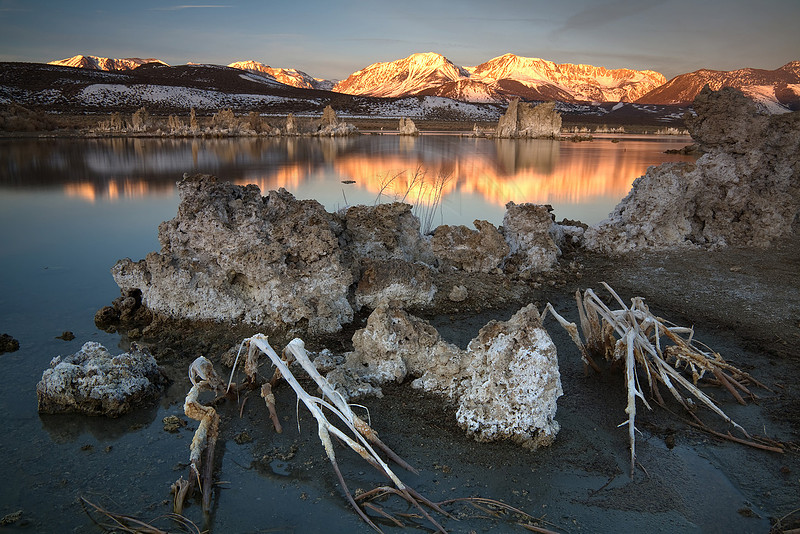
 Two dead plants were framed to be in the foreground. The image was shot from low down to minimize the size of the water. The color of the mountains draw the viewer in. The separation of the foreground from the background creates depth. The sky did not have much color or interest so not much of it was included. Close your eyes and ask yourself to consciously note where your eyes go as you look at the image. You will note that your eye goes back and forth between the dead plants (foreground) and the mountains (background). This is what we want. We do not want the viewer's eyes to just move from left to right and be done. We want the viewer's eyes to move into the image from foreground to background. We want the viewer to perceive depth. The mountains are not placed in the middle of the image as many beginners may have been tempted to do. The dead plants are not placed in the center either. Rather, the mountains are on a third or fifth from the top while the plants are placed on a third to a fifth from the bottom. You can also see that the two plants are placed on a third from each edge laterally.
Spend some time looking at images online or look at a few calendars. Analyze their composition and see what you can learn.
Happy compositioning.
