- Portfolio ▼
- | Blog
- | Affiliate discounts
- | Guestbook
- | Info
- | Contact
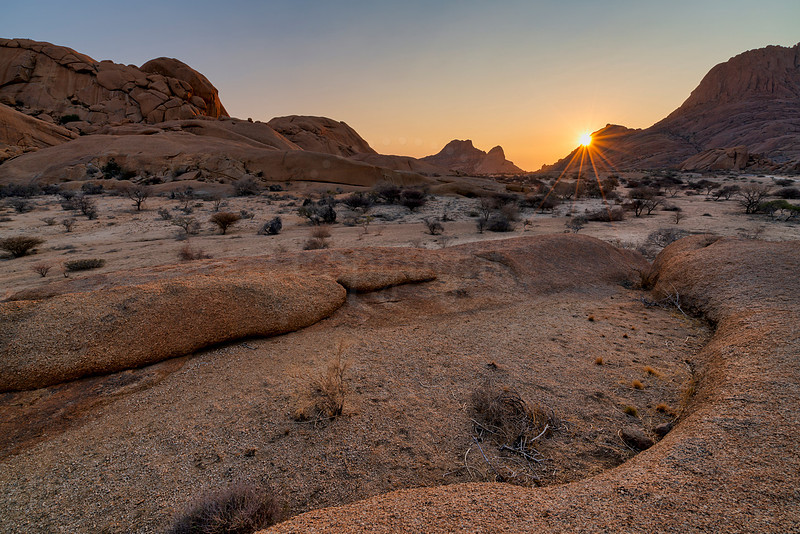
Foreground LinesI have said this many times but it remains important. Foregrounds can often make landscape photographs. An interesting foreground in a landscape image can make the difference between a good image and a great image. Such foreground elements may be flowers, reflections in water, rocks, anything different, anything that stands out. At times these foreground elements are not just small little rocks or flowers or tufts of grass but larger.
This foreground gives the image depth. The two rocks form lines that leads the viewer's eyes to the sun. They tie everything together. I would have wanted to move to the right just a bit so as to make the point where the rocks meet to be right under the sun. However, I could not because I was one of the instructors and had to consider other photographers. We always give our clients the best spots and would not hesitate to move if one of them wanted a certain position. Always think composition! Use elements in the scene to connect, to lead to each other, to point in a direction, to form lines. Be on the lookout for lines, for anything that can direct the viewer's eyes where you want them to go. Moving to the left or to the right, even for some distance, is not going to change the background too much. So once you have your background forget about it and go looking for a matching foreground. It is often the foreground that provides the balance, the lines, more interest, and ties things together. Do the scouting before the light gets nice. When the sun is about to set is not the time to be looking for a foreground. Line up a number of good foregrounds when the light is still harsh and then use them all when the light gets nice. So why do lines work so well in landscape photography? In nature we look at the scene in a three dimentional evironment. We see depth. When we look at an image of the same scene we are looking at a flat two dimentional image. We do not see the depth that was in the scene. In order to dupe the viewer to see the depth (that does not exist on a two dimentional medium) we have to create the illusion of depth. One of the best ways to do that is to make use of lines. The human brain sees the lines and interprets them as depth. When you see lines, jump all over them and include them in your shots. Comments
No comments posted.
Loading...
|
Subscribe
RSS
Archive
January
February
March
April
May
June
July
August
September
October
November
December
|