- Portfolio ▼
- | Blog
- | Affiliate discounts
- | Guestbook
- | Info
- | Contact
Distance on a flat imageYou will hear me say this over and over again. We want people to look into our images rather than from side to side. Let me illustrate:
The image to the left (or top depending on the size of your screen)(the first image) represents a poor image because the viewer just looks at it as a flat image. They look from side to side. They are looking at an image. The picture to the right (the second image) represents a good image because the viewer is looking into the image. This image is not flat as their eyes are drawn into the image. Viewers do not look at an image here they are looking at a scene. It is as if they are there. The image has depth and the viewer almost just needs to take one step forward to be in the scene; they are invited to look deep. In many past blogs I have shared some secrets to help you create the illusion of depth. I say the "illusion" of depth because they will be looking at the image on a flat medium (flat print, flat screen). We employ depth creating secrets to create the illusion of depth. We want the brain to think there is depth. Some of those secrets are (although I am only mentioning a few here; please see many previous blogs for more):
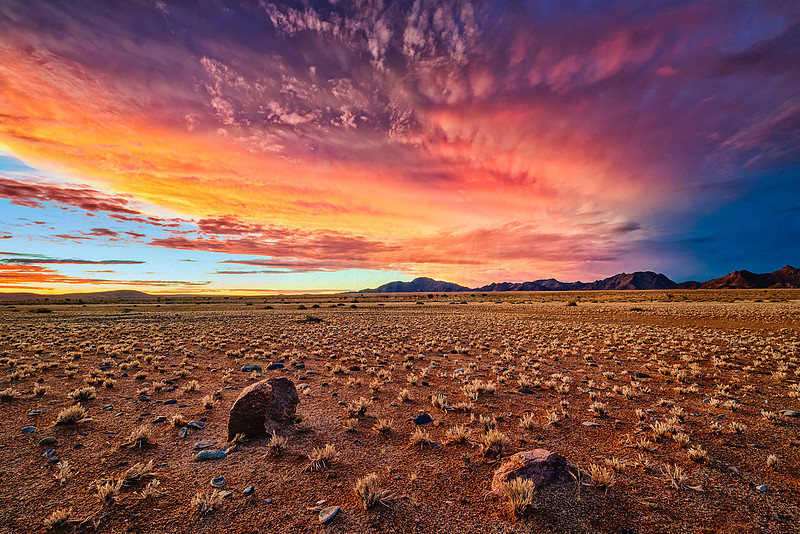
Today I want to introduce another one of these secrets not mentioned before. See if you can find it in this image:
Whenever you find many same sized items scattered throughout the scene use them proactively to create the illusion of depth. The may be rocks, grass, anything really. The red clouds went over me and continued behind me. Yet I deliberately shot into the light to get the grass backlit. This emphasizes them and makes them stand out from the similarly colored ground. Had I shot the other way the grass would hardly have been visible in this light. I am also shooting from a very low angle to help emphasize them. This image then uses a few compositional elements to draw the viewer in. To summarize: we have two foreground rocks, the clouds leading to the mountains, and these same sized tufts of grass all working together to make you see distance. We want the viewer to look from front to back rather than from side to side. Comments
No comments posted.
Loading...
|
Subscribe
RSS
Archive
January
February
March
April
May
June
July
August
September
October
November
December
|