- Portfolio ▼
- | Blog
- | Affiliate discounts
- | Guestbook
- | Info
- | Contact
Do what works for youMost of us have little quirks or things we do simply because they work for us. In photography we all have our way of shooting, our habits, or a sequence we use when we shoot. At times we laugh when we see how others do photography. At times we wonder why we did not think of that because it makes sense and may be helpful. Today I will share one of the little things I do, that when you see me do it, will make you shake your head and question my sanity. Then why do I do it? It simply works for me; it makes my life easier. You are welcome to question my sanity or you can do what I do; you decide! While I shoot I am not only thinking about what is before me, but about what I plan to do with the images in post processing; I shoot and do things with post processing in mind from the get go. I decide while shooting and shoot for blending images. I decide why I want to blend multiple exposures to achieve a set goal and then I shoot to get each of the exposures for the blend. Let's say I am making an image of a forest stream. The wind is blowing. I have a problem. I want to use a long shutter speed to show the motion of the water flowing; that milky look. However, a long shutter speed will render the foliage out of focus because the wind is blowing them around and they need to be sharp. Only a fast shutter speed is going to freeze their motion and give me sharp leaves. I have not yet figured out a way to use a slow shutter speed and a fast shutter speed while taking one single image. So I make two images; one with a slow shutter speed for the water and one with a fast shutter speed for the leaves. By the way, I get different shutter speeds by using ISO not F.Stops because I don't want to effect my depth of field. Similarly I may shoot a sequence for focus stacking (I have a previous blog about this), or an image for the sky and one for the foreground, and don't forget the sequence for a panorama. Here is the problem, when I am out in the field shooting, I shoot - a lot. I may come back with many, many images. When I look at them on my computer I see hundreds (sometimes a thousand or two) of thumbnail images. Now remember, some of those images are simply single images to be processed while others are part of a sequence for blending. When I look at these thumbnail images I cannot figure out where a sequence begins and where one ends. I cannot remember which images where taken for which purpose. To enlarge every image and to look at all the surrounding images that carefully to figure this out will just take too much time. This leaves me frustrated and weary. The solution - I do my little thing while shooting. For panorama sequences I always shoot them left to right. I place my finger in front of my lens and point to the right and take an image; yes, with my finger in the image. I then remove my finger and take the real shot, and the next and the next, until the sequence has been captured. Now I shoot the last image again, this time with my finger in it again, but pointing to the left. Now when I see hundreds of thumbnail images on my computer I know that the images between my fingers are for a pano. Similarly, I point my finger down for the foreground image and after I also took the sky or background image I point my finger down. When I see these thumbnail images I know that they are intended to be blended bottom to top. For focus stacking I point into the scene for the first image and back towards my camera after the last image. I know this sounds strange and people who see me do this think I am crazy. Please consider the following example:
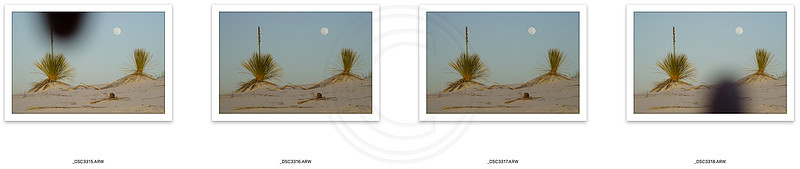
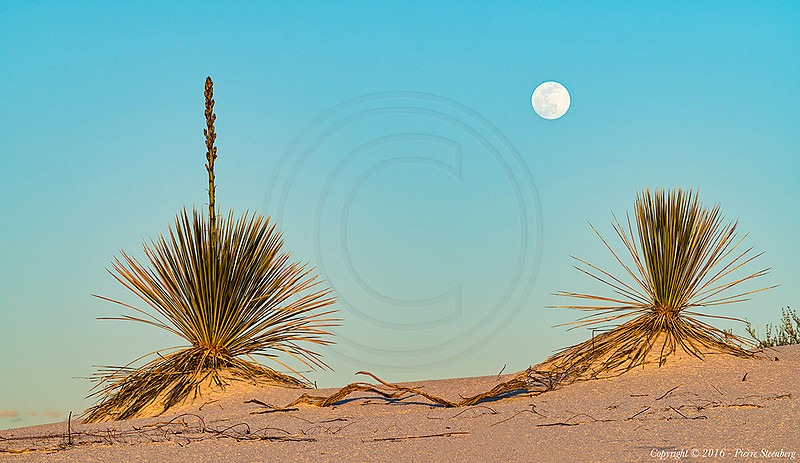
Looking at thousands of images trying to figure out what I had in mind when I took them is no longer a problem for me. Here I wanted to capture the Yucca plants with the moon. Using a wide angle lens would have left the moon too small for my liking. So I used a longer lens to get the moon a decent size. Longer lenses have shallower depth of field. If I focused on the Yuccas the moon would not have been sharp and if I focused on the moon the Yuccas would have been too soft. Two images solve this problem; one is focused on the foreground and the other on the moon. When I see fingers in my images I know the images between them are intended to be blended. The first one after my finger is the one with the sharp plants (the finger points down to the foreground). The second one has a sharp moon (the finger is pointing upward). Seeing my fingers and knowing what that means saves me from inspecting every image, enlarging them and trying to remember what I was thinking at the time. Here is the result:
The goal was to get sharp foreground plants and sharp a moon without spending hours painstakingly examining thousands of thumbnail images trying to find the right sequence of shots amongst hundreds of others. So there you have it; a little technique that works for me. What little things do you do that just works for you? Please let me know. Comments
No comments posted.
Loading...
|
Subscribe
RSS
Archive
January
February
March
April
May
June
July
August
September
October
November
December
|