- Portfolio ▼
- | Blog
- | Affiliate discounts
- | Guestbook
- | Info
- | Contact
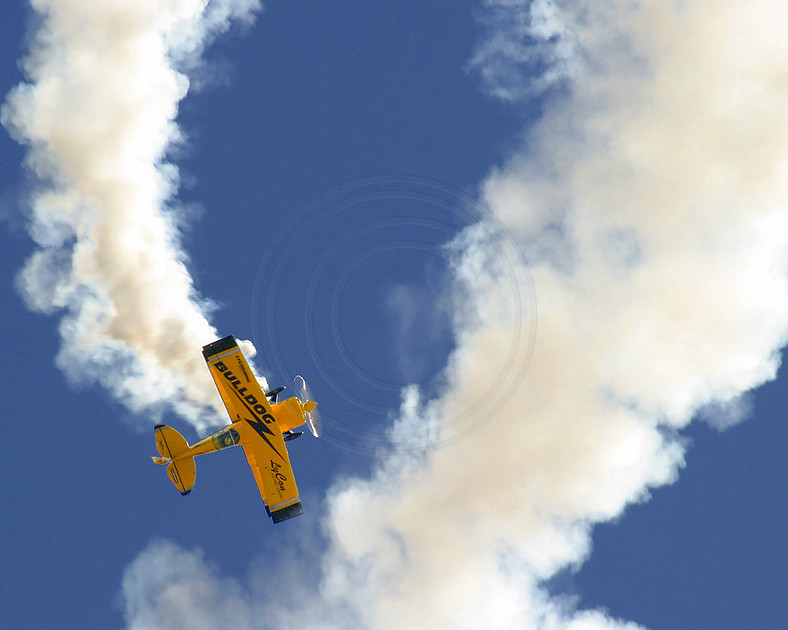
Airshows ...Airshows provide a nice photo op. Take a long lens for in-flight shots. Take shorter lenses for parked planes. What are some of the best practices for shooting airshows? Let's look at a shot first:
Include more than just the plane. So sometimes you just do not have a long enough lens (they do not come cheap). This plane was just too small in the frame to make a good shot. The solution is to include more than just the plane in the shot. Here I have used the smoke to create movement. You can see what route the plane traveled. It tells a story rather than seeing a plane hang in the air with a boring blue background doing nothing. Watch your composition. Place the plane well if it does not fill the frame. There needs to be room for it to fly into. It must fly into your shot, never leave your shot. We do not want the viewer's eyes to leave our shot while it follows the place out of the shot. It is the composition that makes this shot what it is. Choose your shutter speed wisely. Shutter speeds can be a challenge during airshows. When we shoot jets we need to use very fast shutter speeds in order to freeze them in the air. So we bump up our ISO slightly, choose a large F.Stop and fire away with our fast shutter speed. Then come the propeller driven planes. If you shoot them using the same settings you are going to have a problem. The propeller will be frozen (it will not show any motion). In fact you will see the propeller's blades standing still. This does not look right. So the trick is to choose a shutter speed fast enough to freeze the plane BUT slow enough to show the propeller's motion. Luckily the propeller is moving much, much faster than the plane. So we choose a shutter speed of a 60th of a second or perhaps 80th of a second. Now we have another problem; shooting with those shutter speeds using a long telephoto lens is not a good idea because camera shake will cause blurry shots. The best lenses to use for this purpose are lenses with image stabilization (Nikon calls this VR, Sony calls it OSS, and Canon calls it IS). This allows you to shoot using slower shutter speeds and still get sharp images. Note that this technology does not help with the moving plane, it only helps with your moving camera. So your shutter speed still needs to be fast enough to freeze the plane. Use a monopod. Let the monopod take the weight and help you stabilize your camera somewhat. Holding a heavy long lens for hours on end is tiresome. How about attending an airshow?
Comments
No comments posted.
Loading...
|
Subscribe
RSS
Archive
January
February
March
April
May
June
July
August
September
October
November
December
|